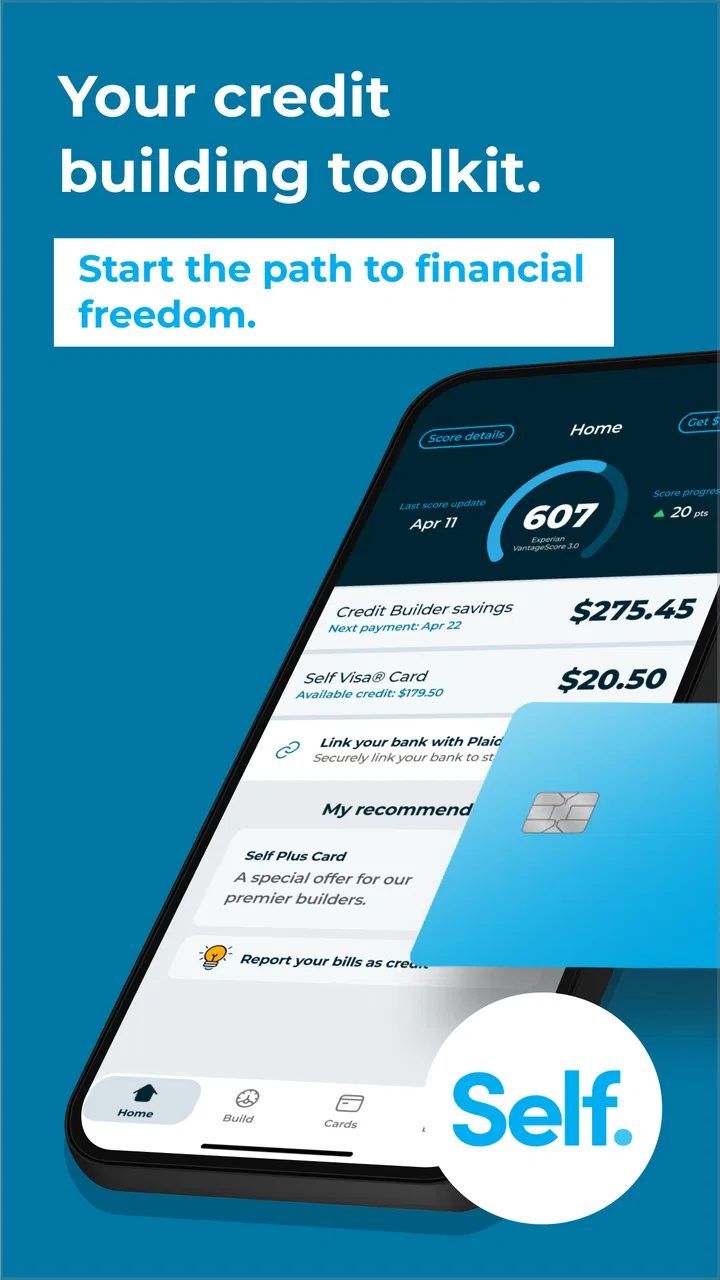
Self - Credit Builder & Cards
- 4.7
- Rating
- 1.00M
- Installs
- Free
- Price

 Analysis by App-foxy
I approached Self – Credit Builder & Cash as a practical finance app rather than a quick-credit shortcut. Its purpose is easy to understand: it gives people a way to work on their credit profile or access cash without requiring a traditional credit check at the starting point. In everyday use, that makes it most interesting for someone who has limited credit history, is rebuilding after financial problems, or wants a more structured way to create positive payment activity.
The app comes from Self Financial, Inc. and is free to download. It is rated for Everyone, so its presentation is approachable, but the subject itself deserves careful attention. Credit products can affect real budgets, and an app that looks simple can still involve commitments, eligibility decisions, and repayment responsibilities. My overall impression is that Self is useful when treated as a deliberate financial routine, not as emergency money that can be taken casually.
Its public reception is strong, with a 4.4 average from around 91 thousand ratings and more than a million installs. That level of adoption suggests it has become a familiar option in the credit-building space. I would still encourage anyone considering it to read every offer and repayment detail inside the app before accepting anything, because the right choice depends on personal cash flow rather than popularity.
You May Also Like

 Blood Strike: 2.5 Anniversary
Blood Strike’s Loadouts Turn Every Drop Into a Tactical Gamble
A close look at Blood Strike’s custom loadouts: how fast access to signature weapons reshapes its battle royale rhythm, rewards preparation, and narrows the gap between fights.

 Pandora - Music & Podcasts
Pandora’s Music Is Easy to Start, but Harder to Recover
Pandora’s strength is its low-effort path from a seed to a station. Its weak spot is how much confidence it asks you to place in connection, setup, and quiet recovery.

 8 Ball Pool
 Is Built on Rivalries, Rematches, and Routine
A close look at the rivalries, rematches, shared routines, and unanswered safety questions that turn a quick pool match into a persistent mobile community.

 Samsung Music
’s Quiet Strength Is Playing What You Already Own
Its reach comes less from spectacle than from dependable access to a personal library. That simplicity is both the app’s strongest retention engine and its ceiling.

 AccuWeather: Weather Radar
AccuWeather Review: A Quick, Clear Forecast for Everyday Decisions
For everyday plans, the best forecast is the one you can understand quickly. AccuWeather makes rain timing, radar, and local conditions easy to act on, with a few trade-offs.

 Hill Climb Racing
Why Hill Climb Racing Still Turns Crashes Into One More Run
A tiny car, a bumpy hill and one more upgrade: Hill Climb Racing keeps resurfacing because its simple chaos makes every near-miss feel personal.
More From Our News Desk



How I would use Self from the first day
I’d treat the first day as a chance to set a sustainable routine, not to rush toward the largest option the app presents. Before starting, I would write down my comfortable monthly limit and the date I can reliably review payments; that small preparation makes it easier to judge each choice on its terms. With that baseline in place, I’d move on to the checks that help prevent avoidable setup friction.
A simple baseline workflow
I would begin by installing the app and completing the initial account and identity steps carefully, using information that matches my financial records. The important habit here is not rushing through the screens just because the app is free. A credit-building product only helps if the account is managed consistently, so I would first decide what monthly amount fits comfortably alongside rent, utilities, food, and existing bills.
From there, I would review the available path for building credit and separately consider whether the cash option actually solves a need. These are related parts of the same app, but they should not be treated as interchangeable. Building a payment record is a longer-term project. Accessing cash is a short-term decision that can add another obligation. Keeping those goals separate makes the app much easier to evaluate honestly.
One realistic scenario would be a person who has recently moved to the country and has income but little established credit history. They might use Self to create a predictable payment habit while keeping the monthly commitment small enough to survive an unusually expensive month. That approach is more sensible than choosing the largest available option simply because it appears on screen.
I found that the most useful mental model is “scheduled financial maintenance.” I would put the due date next to other recurring bills, check the account after each payment, and avoid assuming that one successful month changes everything immediately. Credit improvement is gradual, and the app cannot replace responsible use of a credit card, timely payments on other accounts, or a realistic household budget.
What the app is really good at
The strongest part of Self is its focus. Many finance apps try to combine budgeting, investing, banking, credit monitoring, and rewards into one crowded dashboard. Self is narrower. It concentrates on credit-building and cash access, which can make the next action easier to understand for someone who does not want a complicated financial control center.
That focus is especially helpful for people who have been turned down by conventional credit products or who are unsure how to begin establishing a record. The lack of a traditional credit check for the advertised starting process may make the app feel more accessible, but I would not interpret that as guaranteed approval or guaranteed improvement. The available path still depends on the information requested and the terms shown during the application.
Another useful quality is that the app can give a user a repeatable place to review progress and obligations. I would use that review as a weekly or biweekly check-in, not as something to open only when a payment is late. A quick routine—confirming the next due date, checking the balance or status, and making sure the linked payment method is still usable—reduces avoidable mistakes.
Settings and account details worth checking
Experienced users should spend time in the account and payment areas before relying on the app. I would verify personal details, notification preferences, payment information, and any displayed schedule. Small errors in an email address, bank connection, or payment method can create unnecessary friction later, particularly when the product depends on regular payments.
I would also read the terms attached to the specific offer rather than relying on the general idea of “building credit.” Look for the total obligation, payment timing, possible fees, and what happens if a payment is missed. The app’s free download does not mean every financial service within it is cost-free. That distinction is one of the most important things to understand before proceeding.
Notifications are worth treating as a tool, not as a substitute for responsibility. I would leave useful reminders enabled, but I would also place the due date in my normal calendar. App alerts can be dismissed, delayed, or lost among other notifications. A second reminder outside Self creates a simple backup without requiring any invented automation or complicated system.
If the app presents several choices, I would compare them by monthly pressure and total cost rather than by the amount of cash available. A smaller commitment that can be paid reliably is usually more useful for a rebuilding plan than a larger commitment that makes the budget unstable. This is a trade-off the interface may not emphasize as strongly as the user should.
Faster patterns that make the routine easier
My preferred shortcut is to create one fixed review day each week. On that day, I would open Self, check the next payment, confirm that the payment source has enough room, and close the app. This takes little time and prevents the common mistake of checking only after receiving a warning.
A second pattern is to keep the credit-building payment mentally separate from spending money. If I think of the payment as part of my normal monthly bills, I am less likely to treat it as spare cash that can be used elsewhere. Someone paid every two weeks could set aside a small portion from each paycheck instead of waiting for the full amount to become a last-minute problem.
I would also save a copy of important confirmation screens or statements where appropriate, while avoiding unnecessary storage of sensitive information. The point is to maintain a personal record of what was agreed and when payments were made. If a question later arises, having an organized timeline is more useful than trying to reconstruct events from memory.
For users considering the cash side, I would apply a strict pause rule: wait long enough to write down the reason for borrowing, the repayment date, and the source of the repayment money. If those three answers are unclear, the cash option is probably being used to postpone a larger problem. Self may be convenient, but convenience should not remove the decision-making step.
Where the app needs more caution
The largest limitation is that Self cannot manufacture healthy credit behavior. It can support a payment routine, but it cannot make an unaffordable obligation safe. A missed payment, overextended budget, or misunderstanding of the terms can undermine the very goal that brought someone to the app.
I would also avoid expecting instant results. People rebuilding credit often want a visible change after the first payment, yet financial reporting and scoring are not controlled by a single app interface. Self should be viewed as one part of a longer plan. If the main goal is simply to monitor an existing credit score, a dedicated credit-monitoring service may be more suitable. If the goal is everyday spending and bill management, a bank app or budgeting tool may offer a better fit.
The cash feature deserves particular restraint. Someone facing a one-time emergency may find it useful, but anyone using borrowed money repeatedly for groceries, rent, or other regular expenses should step back and examine the budget. A cash advance or related option can solve timing pressure while leaving the underlying shortfall untouched. In that situation, a nonprofit financial counselor, employer assistance program, or direct negotiation with a bill provider may be a better next move.
There is also a learning curve around financial language. Terms connected with credit reporting, repayment, account status, and eligibility can be easy to skim past. I would not accept an offer while tired, distracted, or under urgent pressure. Reading the full details may feel slower, but it is faster than trying to correct a decision made without understanding the obligation.
Who should choose it, and who should skip it
I think Self is a good match for an adult who wants a focused credit-building app, can make regular payments, and is willing to treat the account as part of a wider financial plan. It may also suit someone with a thin credit file who wants an alternative to immediately applying for several conventional cards. The app’s Everyone rating makes it broadly presented, but financial suitability still depends on the individual’s circumstances.
I would be more cautious if the user already has several debts, frequently misses bills, or is looking for money without a clear repayment source. In those cases, adding another account may create more pressure. It is also not the first choice for someone who wants detailed spending categories, investment research, or a full replacement for a checking account. Self has a narrower job, and that is both its strength and its boundary.
Compared with a secured credit card, Self may appeal to someone who does not want to manage ordinary card spending while building a record. A secured card can offer more flexibility for purchases, but it may require a deposit and careful utilization habits. Compared with a standard personal loan, Self is more clearly aimed at credit-building rather than simply obtaining a larger sum. Compared with a budgeting app, it offers less help with seeing an entire household’s spending picture.
Those comparisons lead to a practical choice: use Self when the main problem is establishing a structured credit habit, not when the main problem is lack of budgeting visibility or a need for broad borrowing options. Choosing the product that matches the actual problem is more important than choosing the app with the most familiar name.
Version, access, and day-to-day reliability
The current version is 7.3.0, and the app supports devices running Android 5.0 or later. That relatively broad Android requirement makes it accessible to people using older phones, although I would still keep the operating system and the app updated when possible for security and compatibility. The service is also available as a mobile finance option for people who prefer handling account checks from a phone.
Because this is a financial app, I would use a screen lock on the phone, avoid signing in over questionable public networks, and never share verification codes. These are not special Self features; they are sensible habits whenever an app displays personal and financial information. I would also check that the phone has enough storage and that notifications are not blocked, since missed reminders can matter more here than in an entertainment app.
The free installation is convenient, but I would keep the distinction between downloading the app and accepting a financial product firmly in mind. Before tapping through an agreement, I would inspect the displayed terms and make sure the repayment schedule fits my actual income cycle. If the app offers a choice between building credit and receiving cash, I would evaluate each independently rather than assuming that selecting one automatically makes the other worthwhile.
My verdict after using the workflow
Self – Credit Builder & Cash works best as a disciplined starting point for people who need a structured route toward stronger credit and may benefit from a cash option that does not begin with a traditional credit check. Its focused design is easier to approach than a large financial super-app, and the free download lowers the barrier to exploring the service.
My recommendation comes with a clear condition: use it only with a payment plan that remains comfortable in an ordinary month and a difficult one. Check the settings, read the exact offer, create a second reminder, and review the account on a fixed schedule. Those habits matter more than opening the app frequently or choosing the biggest available amount.
For someone with stable income, limited credit history, and patience for gradual progress, Self can be a sensible tool. For someone already struggling with recurring debt or looking for a complete budgeting and banking solution, another option may be better. I would call this a focused finance app with real value when its limits are understood—helpful for building a repeatable habit, but never a replacement for a complete financial plan.
FAQs for Self - Credit Builder & Cards
01What is the main purpose of the Self – Credit Builder & Cash app?
The Self – Credit Builder & Cash app is designed to help users build or improve their credit scores through a secured credit-building account. It allows users to make monthly payments that contribute to their credit history, while also saving money, which can be withdrawn at the end of the term. This dual-purpose approach assists in establishing a stronger financial foundation.
02How does the credit-building process work with Self?
Users open a Credit Builder Account where they make monthly payments that are reported to the major credit bureaus. These payments contribute to building a positive credit history. The funds are saved in a certificate of deposit (CD) and are accessible to the user once the term is completed. This process helps improve credit scores with consistent, on-time payments.
03Are there any fees associated with using the Self app?
Yes, there are fees associated with the Self app. Users must pay a non-refundable administrative fee when opening a Credit Builder Account. Additionally, there may be interest charges and a monthly service fee. Being aware of these costs is crucial for users to accurately plan their financial commitments while using the app.
04Is the Self app secure and how is my personal information protected?
The Self app prioritizes security by employing bank-level encryption to protect users’ personal and financial information. It ensures that all data transactions are secure and compliant with industry standards. Users can have peace of mind knowing that their information is handled with the utmost care and protected against unauthorized access.
05Who can benefit the most from using the Self app?
The Self app is particularly beneficial for individuals with little to no credit history or those looking to rebuild their credit scores. It provides a structured way to demonstrate financial responsibility through regular, on-time payments. Young adults, recent graduates, or anyone seeking to enhance their financial standing can find significant value in using this app.
Pros
- Helps improve your credit score.
- Automated savings feature.
- Easy-to-use interface.
- No hard credit check required.
- Wide range of educational resources.
Cons
- Monthly fee applies.
- Limited customer support options.
- Funds access can be slow.
- Not available in all regions.
- Requires bank account linking.

Self - Credit Builder & Cards
Gallery